
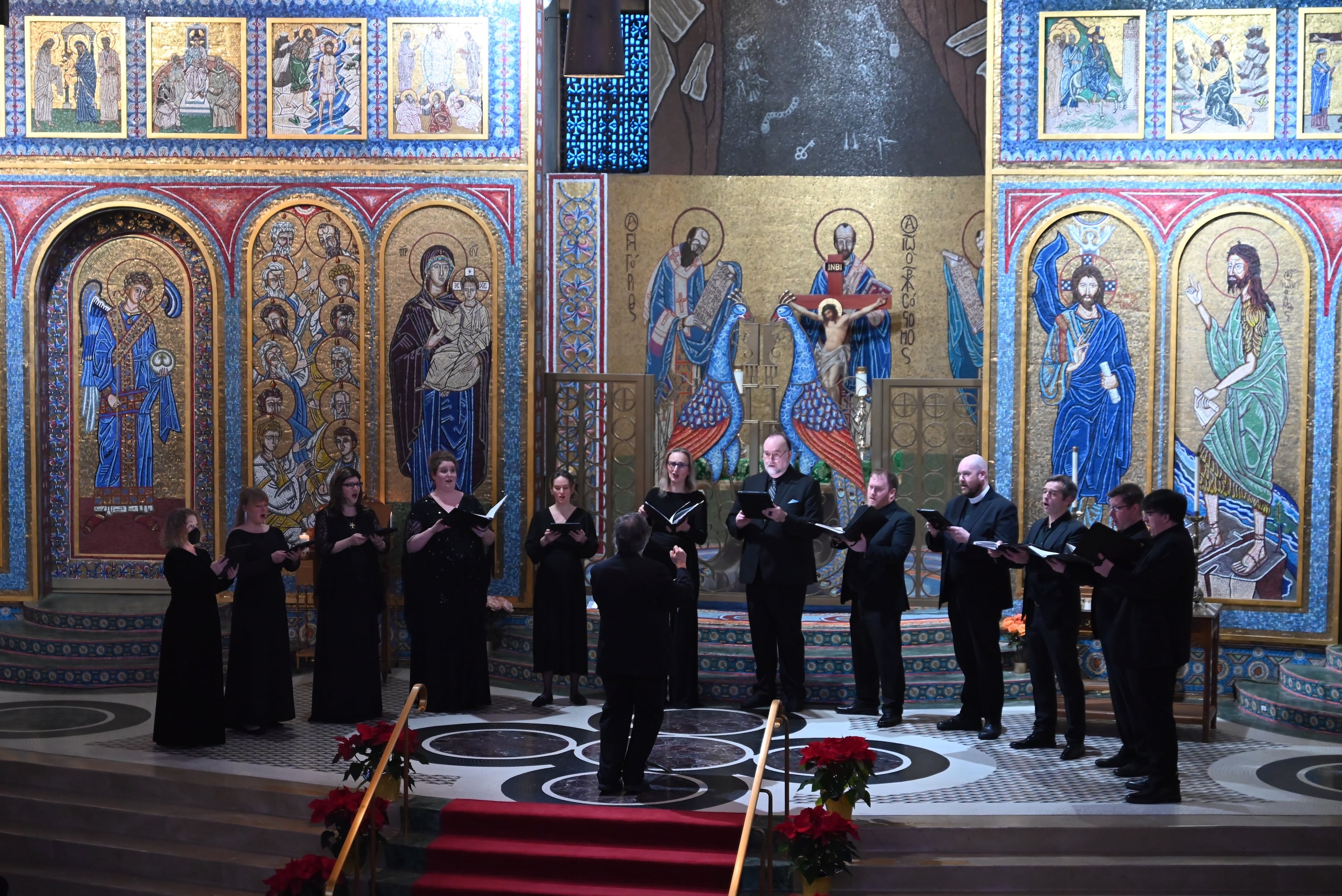
All-Night vigil

Sergei Rachmaninoff

Cappella Romana
John Michael Boyer, Interim Music Director

SEATTLE

Fri 16 Oct 2026, 7:30 PM
St. Mark’s Episcopal Cathedral
1245 10th Ave E
Seattle, WA 98102

Call 503-236-8202 to join the Waitlist

PORTLAND

Sat 17 Oct 2026, 2:00 PM
St. Mary’s Cathedral
1739 NW Couch St
Portland, OR 97209

San Francisco

Sun 18 Oct 2026, 3:00 PM
Holy Trinity Greek Orthodox
999 Brotherhood Way
San Francisco, CA 94132

UPDATE: SEATTLE’S CONCERT IS SOLD OUT. PLEASE CALL 503-236-8202 TO JOIN THE WAITLIST!

Program

Sergei Rachmaninoff  (1873-1943): All-Night Vigil

Composed in 1915, Sergei Rachmaninoff’s All-Night Vigil stands as one of the most beautiful choral masterworks ever written—a luminous bridge between ancient Slavic spiritual traditions and late-Romantic expression, with bass notes so low they challenge the limits of the human voice.

Drawing deeply from ancient Russian Orthodox chants, Rachmaninoff weaves the timeless melodies of Russian plainsong into works of transcendent beauty. Cappella Romana presents the Vigil as intended, with unadorned Russian chants filling out the Vigil — palate cleansers between Rachmaninoff’s sumptuous courses.

This is music that transforms—an outpouring of profound emotional and spiritual vision that finds beauty in darkness. This performance won’t last all night, but you’ll wish it did.

“No, Sergei Rachmaninoff’s 1915 choral classic ‘All-Night Vigil’ doesn’t really last all night, but many listeners will wish it did, especially when Portland’s own Cappella Romana’s impossibly low, resonant bass voices kick in. Beautifully blending Slavic song traditions with late Romanticism, the hour-plus-long sacred work is here accompanied, as the composer intended, by Greek, Ukrainian and other ancient chants, all sung by the ideal interpreters.”

—Brett Campbell, The Oregonian

It is said that on any given day, year-round, Handel’s Messiah is being sung somewhere in the world. Perhaps the only other work of choral repertoire that even approaches this level of popularity is — against all odds — Sergei Rachmaninoff’s All-Night Vigil. That a collection of selected movements from the Eastern Orthodox order of Vespers, Matins, and the First Hour, by a Russian composer best known for symphonic works and piano concerti, and sung a cappella in Old Church Slavonic would become one of the most frequently sung works in history is nearly unthinkable. And yet for decades, the Vigil has captured the hearts of both listeners and performers around the world. 

Rachmaninoff composed the entire work in the span of just two weeks in early 1915. It was premiered by the Moscow Synodal Choir, a men’s and boys’ ensemble under the direction of Nikolai Danilin, on the 23rd of March that same year, partly as a benefit for the Russian war effort. Its enthusiastic reception led to five more performances over the course of the next month. 

One can only speculate as to what might have happened if the work’s popularity had been allowed to spread and take root over the course of subsequent years and decades, but the Communist Revolution of 1917 and founding of the Soviet Union resulted in a moratorium on performances of sacred music. It would be another 50 years before the Vigil would finally be recorded, by Aleksandr Sveshnikov and the State Academic Russian Choir of the USSR in 1965. It was then recorded another seven times over the next 25 years, mostly by Soviet ensembles. 

Its first American recording was by the Choral Arts Society of Washington under Mstislav Rostropovich in 1987, followed closely by the Robert Shaw Festival Singers’ landmark recording in 1989, which was nominated for both Best Classical Album and Best Choral Performance at the GRAMMYs and won for Best Engineered, Classical — and included our own octavist Glenn Miller among its voices. Since then, it has been recorded a total of 47 times, been nominated for six GRAMMY Awards and won Best Choral Performance once, while remaining a favorite for professional, academic, and community ensembles everywhere.

And yet, on its face, it remains a peculiar work both in the context of Russian sacred choral music and within the classical choral world generally. Although Rachmaninoff set chant melodies from three Slavic traditions (Znamenny, Kievan, and “Greek”) as the melodic skeleton for his work (as well as original melodies in the same style, Rachmaninoff’s “conscious counterfeits”), the Vigil  is rarely performed liturgically in the Orthodox Church, apart from occasional incorporation of single movements. Rather, it is generally considered a concert piece, despite its incorporation of liturgical elements that have little place in the concert hall. Further, interplay between more familiar, traditional chant harmonizations and Rachmaninoff’s own, more romantic and exploratory styles of polyphonic counterpoint should by all rights make for a confused and incohesive whole — yet it is precisely this interplay which holds the work together in balance, with each movement presenting a different approach to its chant. 

One might assume that Rachmaninoff would set the old chant melodies in a traditional manner, reserving his more secular, orchestral-style approach for his own melodies; in fact, the opposite is true: when we hear unison chant or homophonic stacked chords moving together in traditional harmonic progression, it is Rachmaninoff’s own “conscious counterfeits” which make up the melody. The traditional chant melodies he most often sets in his most orchestral style, with few exceptions. In this way he seems to seek to validate his own original melodies in the context of the ecclesiastical tradition while showing just how far one can take the old melodies as vehicles for compositional expression. The resulting work is a revelation in both cases. 

As is to be expected in Cappella Romana programs, we have supplemented Rachmaninoff’s settings of the liturgical ordinary with propers for the current period, in this case, resurrectional texts for the Sunday of the Third Mode or “Tone” (the mode of this Sunday), and hymnography from the Sunday of the 318 Holy Fathers of the Seventh Ecumenical Council in Nicæa (Oct. 11 – 17). In the spirit of our season’s theme, “Chant Encounters,” each selection is a plainchant melody from the Znamenny tradition, with two exceptions: the Evening Prokeímenon, “The Lord is King,” is taken from the 16th – 17th century three-part polyphonic Strochnoy repertoire; and the Tropárion (Apolytíkion) for the Sunday of the Holy Fathers, composed in the style of traditional Znamenny Chant, is my own “conscious counterfeit.”


 — John Michael Boyer